
Discus’ eye size

Discus' eye size
by Paul Butler
Hello international friends of Mondodiscus!
Not for my merit but for the kind permission of the administrators of Simplydiscus (www.simplydiscus.com ) I can show you this great Article by Paul Butler that explain us clearly what is meant for Eye size. The same post is in the University section of Simplydiscus’s Forum. Further, and in order to understand better how a discus can be evaluated you’ll find the evaluation scheme that I found in the forum with a short decription of the terms.
As usual we don’t steal you other time and we wish you a good new read with us!
When discus are assessed people often refer to a "nice size eye" or "the eye is too big" or "it has a small eye". I have been asked on a few occaisions to explain what is meant by a good size eye and a too big size eye.
In the picture there are 2 sets of of 2. The set on the left is of an oversize or big eye, the set on the right is of a good sized eye, in this particular case it is notable as it is on a wild caught discus. Wild caughts are often thought to have big eyes.
On many of the newer strains of domestic discus the eye count is now heading around 9 to 9 1/2. In the older strains and wilds then 7 1/2 "eyes" is considered correct. It was Jack Wattley that originated this measure. The eye count is measured vertically.
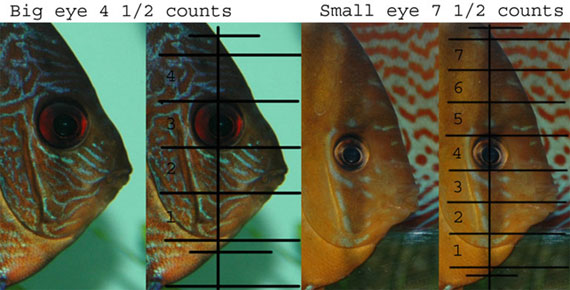
photo by PAUL BUTLER
Finally the decimal evaluation scheme; each point is evauated from a minimum of 0 to a maximum of 1. To have the final judgement of the fish just add the points!
EYES
We have already speak of it from the point of sigh of the correct dimension. But is also considered the colour in accordance to the type of discus.
SHAPE
Is considered the shape of the discus in general.
Si valuta la forma complessiva dell’animale che chiaramente dovrà tendere al circolare
PATTERN
Is considered the fidelity of the discus to the pattern of reference, and how the pattern is evidenced on his body.
LACK OF BLEMISHES
Si considera complessivamente l’animale vagliano i possibili difetti quali ad esempio gobbe o “salti” nella parte frontale o disarmonie nel corpo, difetti nella composizione o forma delle branchie, delle pinne e simili.
STRAIN
Is considered how the fish reveal his belonging to a particular strain.
FINAGE
Are considered the fins and how they are built, soft transaction from hard spines to soft part, symmetry and disposition on the body… ecc.
ROUNDNESS
In relation of the body of the fish
COLORATION
How are colors of the fish vivid or not or in sintony with the pattern of reference.
BODY
How is the body of the discus in relation to dimensions and tickness.
PRESENTATION
It is basically how the fish struts its stuff i.e. attitude, fines erect, etc
This specific areas used Simply Discus scoring system highlights are considered in European judging, but not to the level of granularity here used. Typically a fish will start with a hundred marks and for each "fault" will lose some marks depending upon the severity of the flaw or fault. In Europe the pattern of the discus, and in some case the classification (solid, striped etc) is determined by drawing a D from just behind the eye back toward the tail. It is this area that determines how it scores on pattern and colouration.
The other thing that a lot of European and Asian judges do is to quarter the discus and compare the quarter above the line to the one below, they are looking for symmetry here.
Asian judges, and some European ones too, do not consider things like weak chins and cichlid humps as flaws, whereas most American judges and a high number of European judges do.
In the big European tournaments, e.g. Duisburg, discus will be disqualified if they are classified wrong.
We hope that this article wil be useful! For the ones that in future will be judge in a discus contest but also for the ones that want to do a good buy !

| Liquido miracoloso o acqua fresca? | Le tartarughe |
| Liquido miracoloso o acqua fresca? | |
| Le tartarughe |